18 Anonymous Order Resolution Program
18.1 Bringing Invisible Revenue Into View
The anonymous resolution program is the most capital-efficient initiative in this report. It requires no new customer acquisition. It takes revenue the business is already generating and makes it trackable, contactable, and retainable.
If the business can retroactively match just 20% of its anonymous backlog to known customer addresses, it converts roughly £302.15K of untraceable revenue into identified relationships. A 30% match rate pushes that figure to £453.23K. These are not new customers — they are existing customers whose revenue shifts from invisible to visible.
18.1.1 The Resolution Picture
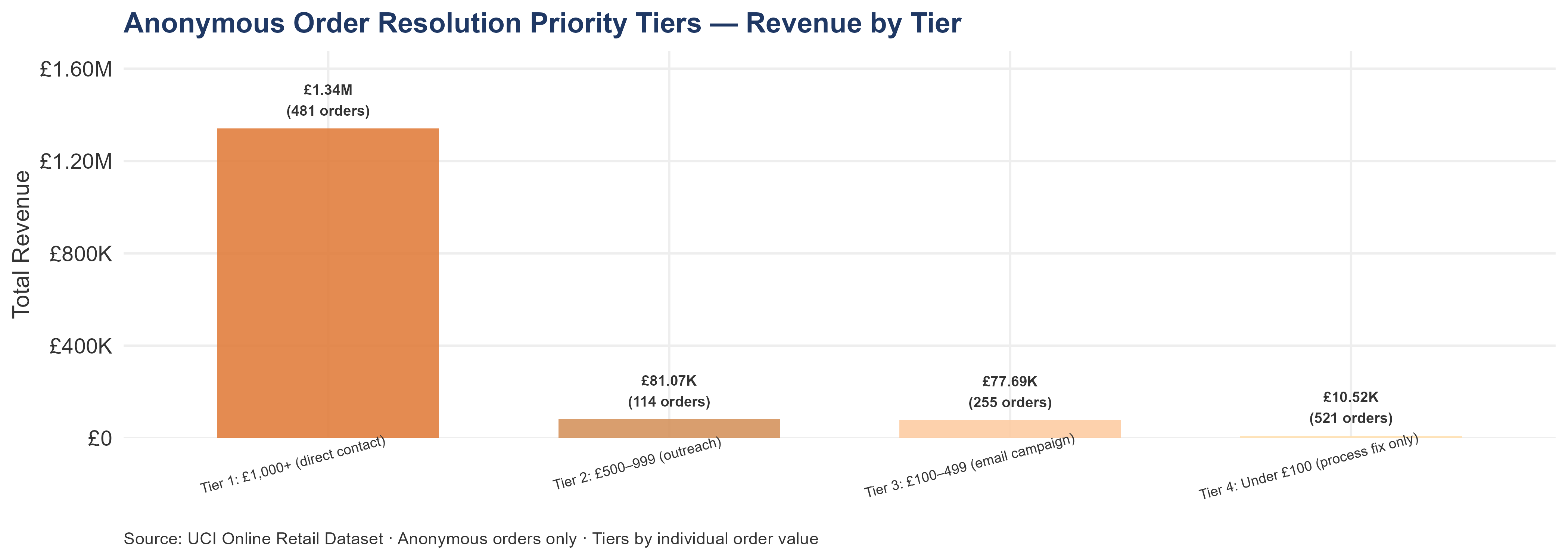
The 481 Tier 1 anonymous orders account for 88.80% of all anonymous revenue — concentration is structural. Tier 1 orders represent 88.80% of anonymous revenue from only 35.08% of anonymous orders. At this value, a personal phone call from the resolution team is justified — the cost of one contact is trivial relative to the LTV of a converted account. These 481 orders are the priority list — start here before running any broad outreach program.
If 20% of anonymous orders are matched to existing accounts, the acquirer recovers £302.15K in attributable revenue — at analyst cost, no customer contact required. Address matching against the identified account database is the lowest-cost first action: no outreach, no process change, no IT project. This is a day-1 action — run the match before any outreach program is designed. A 30% match rate recovers £453.23K in attributed revenue. Matched records enter the retention system immediately upon attribution.
Anonymous-order concentration is actionable in Eire (9.15%) and the UK (7.39%). Unspecified’s headline 38.46% rate is a data-integrity artifact, not a market signal. Among markets where the country field is populated, Eire and the UK carry the highest anonymous-order rates against a meaningful order base — 26 of 284 Eire orders (9.15%) and 1,322 of 17,901 UK orders (7.39%) are anonymous. These are the two priority targets for channel-by-channel audit: a specific ordering script, account-creation flow, or call-center process is producing the rate, and the fix is targeted rather than system-wide. The Unspecified bucket reports a 38.46% anonymous rate (5 of 13 orders), but the country field is itself missing for those rows — the finding is that missingness compounds with CustomerID absence, not that a market called “Unspecified” is a risky geography. The Process Gap Analysis section of this chapter recommends excluding Unspecified from market-level process investigation and treating it as a separate data-integrity problem.
Every anonymous customer converted to an identified account enters the retention system at the starting point their first order establishes — the forward LTV is immediately computable. An anonymous customer who creates an account becomes a UK Identified account (if UK) or an international identified account with a documented first order. Their forward 3-year LTV is £1.24K (UK) or £1.59K (International) from the moment of conversion — they enter the full retention and follow-up pipeline. Each converted account adds its full segment LTV to the forward portfolio, less the first-order value already received.
Making CustomerID mandatory at order entry is the only permanent fix — every other resolution pathway is retroactive repair of a continuing problem. Address matching, phone outreach, and email capture all fix past anonymous orders. None of them prevent new ones. The business will continue generating anonymous orders at 6.93% indefinitely until the order entry systems are changed to make CustomerID capture mandatory. Pre-close, ask the seller whether this fix has been scoped, what the IT cost is, and what the timeline is. If the seller cannot answer, the IT fix becomes a post-close priority with unknown cost.
18.1.2 The Resolution Opportunity — What Identity Recovery Is Worth
The current state: 1,371 orders totaling £1.51M have no CustomerID. These orders generate revenue but create no commercial intelligence. The business cannot determine whether an anonymous customer is new or returning, what their lifetime value is, or whether they should receive follow-up.
What conversion is worth:
| Scenario | Orders Matched | Revenue Attributed | 3-Year LTV Gain |
|---|---|---|---|
| 20% address match | 274 | £302.15K | — |
| 30% address match | 411 | £453.23K | — |
| 20% match + 50% become active accounts | 274 | £302.15K | £170.42K |
| 30% match + 50% become active accounts | 411 | £453.23K | £256.24K |
The revenue attribution figures (columns 2–3) are not new revenue — the business already collected it. What changes is that the revenue becomes visible in customer records, segment analyses, and LTV projections. The 3-year LTV gain (column 4) is new forward value: accounts that were previously invisible become manageable relationships with documented forward projections. The match rate assumptions (20% and 30%) are illustrative — the actual rate depends on address data quality and matching algorithm design. The resolution team should target the 30% rate and measure against it.
18.1.3 Resolution Pathways
Pathway 1 — Address-Based Matching (lowest cost, highest ROI)
Compare shipping addresses on anonymous orders against the identified account database. An address match is a probable identity match — the anonymous order likely belongs to an existing account that bypassed CustomerID on this transaction. No customer contact required. Start with the last 90 days; expand to the full 12-month backlog.
Pathway 2 — Direct Contact for Tier 1 Orders (£1,000+)
These 481 orders sit at £1,000 or above. Each warrants a personal phone call: “We recently fulfilled an order for you and wanted to make sure everything arrived correctly. We’d like to set up an account for you so we can provide a better experience going forward.” The framing is service, not sales.
Pathway 3 — Email Capture for Tier 2–3 Orders
For orders between £100 and £999, include an account creation prompt with the delivery confirmation. The message should state the specific benefits: order history, faster reordering, priority fulfillment, and a dedicated contact. One prompt per delivery, not a campaign.
Pathway 4 — Process Fix for Tier 4 (under £100) and All Future Orders
Making CustomerID mandatory at order entry across all channels. This is not a resolution pathway — it is a prevention pathway. It stops generating new anonymous orders at the source.
18.1.4 Priority Tiers for Resolution
| Tier | Orders | % of Orders | Revenue | % of Rev | Median Value | Action |
|---|---|---|---|---|---|---|
| Tier 1: £1,000+ (direct contact) | 481 | 35.08% | £1.34M | 88.80% | £1.82K | Phone call from resolution team |
| Tier 2: £500–999 (outreach) | 114 | 8.32% | £81.07K | 5.37% | £696 | Personal email + follow-up call |
| Tier 3: £100–499 (email campaign) | 255 | 18.60% | £77.69K | 5.14% | £311 | Account creation prompt with delivery |
| Tier 4: Under £100 (process fix only) | 521 | 38.00% | £10.52K | 0.70% | £12 | Process fix — make CustomerID mandatory |
Work from the top down. Tier 1 has the highest per-order value and the fewest orders — it is the most tractable. A resolution team of one person can contact every Tier 1 order in a week. Tier 2 takes longer but each contact is still individually justified. Tier 3 is volume work — email prompts attached to deliveries. Tier 4 is the process fix that prevents future anonymous orders from being created.
18.1.5 Process Gap Analysis — Why Are Orders Placed Without CustomerID?
The data cannot tell us why orders lack CustomerID. But it can tell us where the gap is most severe, which narrows the investigation:
Geographic pattern: The five countries with the highest anonymous order rates (minimum 10 total orders) show where the process gap is most concentrated:
| Country | Total Orders | Anon Orders | Anon Rate |
|---|---|---|---|
| Unspecified | 13 | 5 | 38.46% |
| EIRE | 282 | 26 | 9.22% |
| United Kingdom | 17,901 | 1,322 | 7.39% |
| Switzerland | 50 | 3 | 6.00% |
| Portugal | 50 | 1 | 2.00% |
Rows labeled Unspecified represent compounded data quality gaps (orders missing both CustomerID and Country), not a real market — they should be excluded from market-level process investigation and treated as a separate data-integrity issue. Among actionable markets, Eire (9.2%) and the UK (7.4%) are the two priority targets: both have material anonymous rates against a large order base, and both fall under channels where account-creation prompts can be operationally fixed.
What this pattern reveals: The anonymous rate varies dramatically by country. This variation is not random — it reflects something structural about how customers in each market reach the ordering process. The diagnostic questions for each high-anonymous market:
- What channel did these orders come through — web, phone, fax, email, third party?
- Does that channel have a CustomerID capture step? Is it mandatory or optional?
- If web: is the ordering interface available in the local language? Does it accept local address formats?
- If phone/fax: was an account creation offer made during order-taking?
- Has any customer in this market ever been offered an account?
A market where 100% of orders are anonymous and zero accounts have been offered has a zero-effort process gap — the fix is offering accounts, not investigating why customers declined them.
18.1.6 Conversion Program Design
Program 1 — Day-30 Outreach for High-Value Anonymous Orders
Every anonymous order above £500 receives a personal contact within 30 days of fulfillment. The contact references the specific order, confirms it was fulfilled correctly, and introduces the concept of a formal account. The framing: “We noticed you placed an order with us recently and wanted to make sure everything arrived well. We’d love to set up an account for you so we can provide order history, priority fulfillment, and a dedicated contact for future orders.”
Owner: Resolution Team. Deadline: program live within 30 days; first contacts this month.
Program 2 — Standing Order Conversion
Identify anonymous orders that share shipping addresses with other anonymous orders. An address that appears on 2 or more anonymous orders is almost certainly a repeat customer. These are the highest-priority resolution targets: they have demonstrated repeat purchasing behavior but remain commercially invisible. Contact each one directly and convert to a named account.
Owner: Resolution Team. Deadline: address-pattern report generated within 2 weeks; outreach begins within 30 days.
Program 3 — Account Creation at Order Entry
The permanent fix. Make CustomerID mandatory at the point of order entry for every channel:
- Web orders: Prompt account creation at checkout confirmation. Not a gate — customers who decline continue as normal, but the prompt is shown on every order.
- Phone/fax orders: Train order-taking staff to make the account creation ask while the customer is on the line. Script: “Can I set up an account for you? It takes 30 seconds and means your next order will be faster.”
- Email orders: Auto-reply with account creation link and stated benefits.
Owner: IT + Operations. Deadline: 30 days for web channel; 60 days for phone/fax/email channels.
Program 4 — Conversion Incentive
Offer a tangible benefit for account creation: early access to new products, a small discount on the next order, or priority fulfillment during peak periods. The incentive does not need to be large — the friction is the absence of a reason to act now. A clear benefit answers that.
Owner: Resolution Team Lead + Marketing. Deadline: incentive design approved within 30 days; incentive live alongside Program 1.
18.1.7 CustomerID Capture Audit
The audit question: For each ordering channel, can a customer place an order without providing a CustomerID? If yes, fix it.
| Channel | Can order without ID? | Fix |
|---|---|---|
| Web | Check checkout flow | Make account creation prompt mandatory (not gating) |
| Phone | Check order-taking script | Add account creation ask to script |
| Fax | Check order form | Add CustomerID field to form; follow up if blank |
| Check auto-processing | Require account lookup before order entry | |
| Third-party | Check integration | Require CustomerID mapping in feed |
Owner: IT + Operations. Deadline: Audit complete within 2 weeks. Fixes implemented within 30 days.
Success metric: The anonymous order rate should begin declining within one month of implementing the channel fixes. If it does not, the fixes are incomplete or the wrong channels were targeted. Re-audit and iterate.
18.1.8 The Resolution Playbook
The playbook is sequential: export anonymous records, run the address match against known customers, contact unmatched high-value orders, resolve country assignment, update the order management system, validate results, and fix the process that generates anonymous orders.
The process fix (step 7) has the highest long-term return because it reduces the volume of anonymous orders the resolution team must deal with in every future period. The backlog match (steps 1–2) captures the immediate upside. Both are necessary — the program is not complete without either one.
The program should be operational before the first Q4 under new ownership. Peak season is when the highest-value orders are placed, and processing them without identity capture means the most commercially important transactions of the year enter the system as dead-ends.
18.1.9 How to Correct Existing Anonymous Records — Operational Playbook
The resolution pathways in 3.2 identify who to contact. This section describes how to actually correct the data — the mechanics of updating existing records so anonymous orders become attributed.
Step 1 — Export the anonymous order backlog. Pull all orders where CustomerID is NULL. Group by shipping address. Every unique shipping address is a potential identity resolution target. Sort by total anonymous revenue per address descending — highest-value addresses first.
Step 2 — Match against the identified account database. For each anonymous shipping address, check whether it matches an address already associated with a CustomerID in the identified account database. An exact or near-exact address match is a high-confidence attribution. Flag matched records with the corresponding CustomerID. This step requires no customer contact and can be completed by one analyst in a day for the top-50 addresses.
Step 3 — For unmatched high-value addresses, initiate contact. For addresses in Tier 1 (£1,000+) that did not match: phone call from the resolution team. Script: ‘We fulfilled an order to [address] on [date]. Can I confirm your account details so we can make future orders smoother?’ If the customer confirms their identity, create the CustomerID record immediately during the call and backdate the attribution to the original order date.
Step 4 — For Unspecified country records, investigate the source channel. Orders where Country = ‘Unspecified’ have a compounded gap: missing both CustomerID and Country. These records are unusable for market analysis until the country is resolved. For each Unspecified order above £500: (a) check the original order document for a shipping address with a resolvable country, (b) if found, update Country from the address, (c) then proceed through Steps 1–3 for CustomerID resolution. If no address is available, flag as ‘Unresolvable’ and exclude from market analysis but retain in revenue totals.
Step 5 — Update the records in your order management system. Once a CustomerID is confirmed for a previously-anonymous order, update the record with: - CustomerID: [resolved account number] - Resolution method: [Address match / Phone confirmation / Email confirmation] - Resolution date: [today’s date] Do not backdate the CustomerID assignment date — only backdate the attribution of the revenue to the account.
Step 6 — Validate. After updating, the anonymous order rate metric should drop. If it does not drop after a batch of resolutions, the updates were not applied correctly. Run a count of NULL CustomerID records before and after each batch to confirm the fixes are taking effect.
Step 7 — Prevent new anonymous records. Complete the channel audit in 3.6 and implement mandatory CustomerID capture. Until Step 7 is complete, Steps 1–6 are remediation of a growing problem. The structural fix is the only way to stop the backlog from growing faster than the resolution team can work.
Owner: Resolution Team Lead + IT. Deadline: Steps 1–2 complete within 1 week (analyst task). Steps 3–4 complete within 30 days (outreach task). Step 7 complete within 60 days (IT task).
Track these metrics monthly. The resolution program is working if all five are moving in the right direction.
| Metric | Baseline (Current) | Target (6 months) | Direction |
|---|---|---|---|
| Anonymous order rate | 6.93% | Below 5% | ↓ Declining |
| Orders matched to existing accounts | 0 | 274+ | ↑ Growing |
| New accounts created from resolution | 0 | 69+ | ↑ Growing |
| Revenue now attributable | £0 | £302.15K+ | ↑ Growing |
| Channels with mandatory CustomerID | Unknown | All channels | ↑ Complete |
The anonymous order rate is the headline metric. If it declines, the structural fixes are working. If it holds steady despite outreach, the process gap has not been closed — re-audit the channels.
18.1.10 LTV Impact — What Converted Accounts Are Worth
Once an anonymous customer creates an account, they enter the identified segment with full LTV projections.
| If converted to… | 3-Year LTV per Account | At 20% conversion (137 new accounts) | At 30% conversion (206 new accounts) |
|---|---|---|---|
| UK Identified | £1.24K | £170.42K | £256.24K |
| International Identified | £1.59K | £218.03K | £327.84K |
Cost of delay (annual run-rate). The 30%-match scenario produces £256.24K in 3-year forward LTV — that total spans the cohort captured in Year 1 plus its retention through Years 2 and 3. Each year of implementation delay loses roughly one third of that total (£85.42K) — the forward LTV from the cohort that would have been captured in that first year but was not. The remaining two-thirds of the 3-year total represents forward LTV from later cohorts, which is still recoverable by implementing the program later (at a one-year-displaced start). The first-year cohort is the irrecoverable portion — customers whose anonymous orders were placed during the delay window cannot be retroactively attributed once the CustomerID capture process is fixed. The Tier 1 orders (481 orders, £1,000+) represent the most commercially critical portion of this run-rate. Delaying this program by one year is not a neutral decision.
The resolution program is not a cost center — it is among the highest-return investments this dataset identifies. Marketing campaigns, outbound sales, and trade-show presence typically cost more per acquired account than running this program. The cost of converting one anonymous customer to an identified account is one outreach contact. The forward value is the full 3-year LTV. The annual run-rate cost of the resolution program — staff time for outreach plus IT time to implement the mandatory CustomerID prompt — is a fraction of the £85.42K annual run-rate of forward LTV at the 30% conversion scenario. The program generates substantially more than it costs at plausible run-rate assumptions.
18.1.11 Team Structure
The transaction data supports three distinct customer management approaches: UK (systematic, volume-based), International (high-touch, named-ownership), and Anonymous (conversion-focused). Whether the right organizational structure is three teams, one team with three playbooks, or a hybrid depends on headcount and tooling considerations beyond this dataset. What the data establishes is the distinction between the approaches — not the org chart.
18.1.12 Resolution Program Summary — Week 1 Post-Close Actions
Week 1 (Day 1–7) — in order of urgency:
Audit every ordering channel for CustomerID capture gaps. Identify which channels accept orders without CustomerID and determine whether the field is optional, hidden, or broken. Owner: Resolution Team + IT. Deadline: Week 1 (Day 1–7).
Pull the top 20 anonymous orders by value from the last 90 days. Begin address-based matching against the identified account database. Any confirmed address match should be retroactively attributed. Owner: Resolution Team. Deadline: This month.
Contact every Tier 1 anonymous order (£1,000+) from the last 6 months. Together these 481 orders are worth £1.34M. Each warrants a personal phone call. Goal: establish identity, not sell. Owner: Resolution Team. Deadline: This month.
Make CustomerID mandatory at order entry across all channels. This is the permanent fix. Every order that enters the system without CustomerID should trigger an immediate flag. The investment is small. The compounding benefit is permanent. Owner: IT + Operations. Deadline: 30 days.
Establish monthly tracking of the five success metrics above. The resolution program is measured by the anonymous order rate. If it declines, the program is working. If it holds steady, the process gap has not been closed. Owner: Resolution Team Lead. Deadline: First report end of next month.
The transaction data suggests three distinct customer management approaches; the specific team structure is an operational decision. The four-report series has documented materially different customer behaviors, LTV profiles, and management requirements across three segments — UK at volume with tier-based ownership, International with high-touch relationship management, Anonymous with identity resolution. Validating the right team structure (headcount, reporting lines, tooling) requires operational DD not included in this analysis; the data supports the distinction between the approaches, not a specific org chart. The approaches the data supports:
- UK management approach (systematic, volume-based): day-30 follow-up, overdue customer outreach, frequency tier progression. Named relationship managers plausibly required only for UK Tier 1 (top 10 accounts by net revenue).
- International management approach (high-touch, named-ownership): named senior relationship ownership for each of the top-4 accounts (14646, 14911, 12415, 14156). Named contact for accounts ranked 11–50. Systematic per-account reorder trigger for remaining accounts.
- Anonymous resolution approach (conversion-focused): outreach, address matching, channel audit, CustomerID capture fix. Customers who convert hand off to UK or International pipeline based on country.
Without differentiated management of these three approaches, the programs documented across the series will compete for the same team’s attention and none will be executed at the required quality. Whether the right structure is three teams, one team with three playbooks, or a hybrid depends on headcount, geography, and tooling considerations outside this dataset.
Owner: COO. Deadline: Approach decision within Month 1 (Days 1–30); structural implementation within Months 3–6.
Author: Shawn Phillips | Lailara LLC
← UK & International Segment Programs | Appendix A — Canonical Values & Methodology →